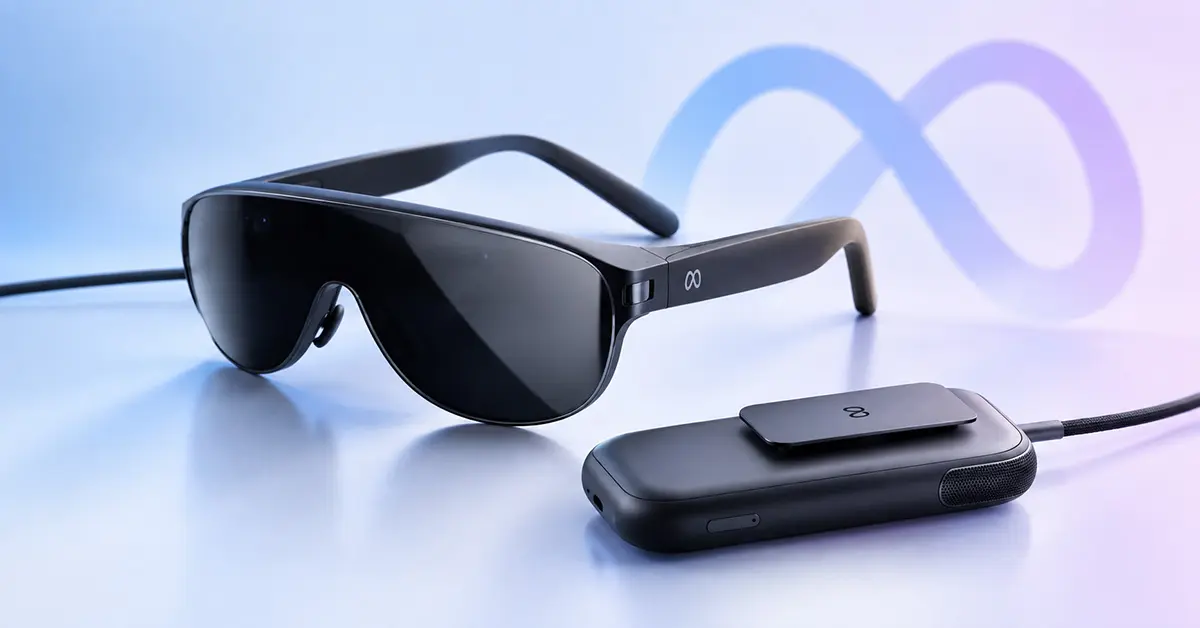
Meta VR Glasses bring virtual reality to a glasses-style form factor weighing about 100 grams. The display and sensors are built into the glasses, while the main computing hardware, battery, and storage are in a separate compute puck. Mark Zuckerberg introduced the Meta VR Glasses during his keynote at Meta Connect 2026 on September 23, giving Meta’s VR lineup a new glasses-style option.
At Meta Connect 2026, held on September 23–24, 2026, Meta showcased how the VR Glasses can be used for movies, live sports, work, and gaming. The company introduced the device as more than a traditional VR headset, with features designed around entertainment and productivity.
Here’s what to know about the Meta VR glasses, including their design, display, processor, controls, gaming and entertainment features, price, and release date.
Table of Contents
A VR Headset That Looks More Like Glasses
Unlike a traditional VR headset such as Meta Quest 3, which has a larger visor and head strap, the Meta VR Glasses are designed to look and feel more like a pair of glasses. Their open design and passthrough camera also help users remain aware of their surroundings while viewing virtual content.
The Secret Behind the Lightweight Design
Meta divides the hardware between the glasses and a separate compute puck. The glasses contain the display and sensors, and weigh about 100 grams. The compute puck handles the processing, battery, and storage and connects to the glasses through an optical tether. Meta says the glasses weigh roughly the same as a deck of cards. Because the puck clips to a pocket or bag, much of the computing hardware is kept off the user’s face.
Inside the 5K Display
The glasses also focus heavily on display quality. The glasses use a 5K Infinite Display based on micro-OLED panels and deliver 37 pixels per degree. Meta says the high pixel density helps make content, including text, clearer and easier to read. They also use compact pancake lenses and support Dolby Vision. Dolby Atmos spatial audio is built into the frames.
What Powers the Meta VR Glasses?
Processing is handled by the external compute puck rather than the glasses themselves. Meta says the Glasses use Qualcomm’s Snapdragon Reality Elite processor, which is housed in the compute puck and is designed to deliver high performance and fast load times. The puck also houses the battery, which Meta says can provide up to three hours of continuous high-resolution media playback. It supports 45W fast charging as well.
Eyes and Hands Are the Main Controls
The glasses are designed around eye and hand tracking rather than physical controllers. Eye tracking and hand gestures are the primary input methods. Users can look at virtual objects and interact with them using hand gestures without reaching for a controller. Touch Plus controllers are supported, but they are not included with the glasses. They are sold separately.
Meta AI Adds Hands-Free Controls to VR Glasses
Meta integrates a Meta AI agent directly into the operating system of the VR. Users can interact with the glasses through voice commands, eye movements, and natural hand gestures without reaching for a controller.
Meta says the agent can help users play movies, adjust the virtual workspace, and search for information using voice, eye tracking, and hand gestures.
Meta VR Glasses vs. Quest 3: What’s Different?
Meta describes VR Glasses as an addition to its VR lineup rather than a replacement for Meta Quest devices. Here is how they differ in design, display, processing, and controls.
Design and Weight
Meta VR Glasses
- Glasses-style form factor
- About 100 grams
- Compute, battery, and storage are housed in the puck
- Connected to the puck by an optical tether
Meta Quest 3
- Traditional all-in-one VR/MR headset
- Processor and battery are built into the headset
- No external compute puck
Meta says the glasses are about five times lighter than the Meta Quest 3, largely because the compute hardware, battery, and storage are moved to the puck.
Display
Meta VR Glasses
- 5K Infinite Display
- Micro-OLED
- 37 pixels per degree
- Dolby Vision support
- Pancake lenses
Meta Quest 3
- LCD display
- 2064 × 2208 pixels per eye
- 25 pixels per degree
- Pancake lenses
Meta VR Glasses have a 70-degree horizontal and 66-degree vertical field of view, compared with 110 degrees horizontal and 96 degrees vertical on Quest 3.
Processing
Meta VR Glasses
- Snapdragon Reality Elite platform
- Processing handled by the external compute puck
Meta Quest 3
- Snapdragon XR2 Gen 2
- Processing hardware built into the headset
The key difference is not just the processor, but where the computing hardware is located. Quest 3 keeps it inside the headset, while VR Glasses move it to the external puck.
Controls
Meta VR Glasses
- Eye and hand tracking
- Voice interaction
- Touch Plus controller support
Meta Quest 3
- Head and hand tracking
- Touch Plus controllers
VR Glasses ship without controllers, but compatible Touch Plus controllers can be purchased separately.
From a VR Screen to a Personal Cinema
Meta is pitching the VR Glasses as more than a gaming device. The company highlights movies, sports, and work alongside gaming as key uses for the device. Meta says VR Glasses are the first IMAX Enhanced-certified VR device, with 3D movie viewing experiences planned for the platform.
The glasses support 3D content and themed virtual viewing environments designed to make movies feel more like a theatre experience. Meta is also introducing hologram calling, which creates photorealistic digital versions of the caller with real-time expressions and reactions. Spatial audio adds to the effect.
Sports are another major focus. Meta says more than 100 immersive live U.S. sports events will be available each year after the Glasses launch, with partners including MLB, NBC Sports, TNT Sports, and UFC.
Meta VR Glasses as a Portable Virtual Office
The glasses can also turn your surroundings into a private multi-screen workspace. Meta says users can connect to Mac and Windows computers and use multiple virtual displays. A flat surface can also be used as a virtual keyboard and touchpad for interacting with the workspace.
Gaming Gets a Controller-Free Option
Meta says more than 75 games will be available at launch that can be played using hand gesture-only play. For games that need physical controls, users can pair Meta Quest Touch Plus controllers, which are sold separately. The glasses run the same operating system, Store, and SDKs (Software Development Kits) as Meta Quest devices. Xbox Cloud Gaming will also let users stream hundreds of games to the glasses. A compatible Bluetooth gamepad can be used for gameplay.
Meta VR Glasses Price and Release Date
Meta VR Glasses will go on sale in Spring 2027 for $1,299.99. Meta has not announced an exact release date yet. Touch Plus controllers are available separately for users who want physical controls for supported games and experiences.

Ajmal has a background in Communicative English and works across digital marketing, web development, content creation, and related digital areas. At Oratraex, he focuses on gaming, digital marketing, technology, and emerging digital trends, helping readers understand content that matters in the digital world.